Key Takeaways:
- The best treatment depends on why the pigment formed, how deep it sits, and how reactive your skin is, so a laser or peel should be chosen after evaluation, not from a treatment menu.
- Chemical peels are often the safer starting point for melasma and superficial discoloration, while lasers are usually the stronger option for deeper pigment and well-defined sun spots.
- The most natural-looking long-term results usually come from a staged plan that may combine laser, peels, topical care, and daily SPF, rather than relying on a single treatment.
Two brown spots can look identical in the mirror and respond to opposite treatments. The laser session that clears a friend’s sun damage may do nothing for your melasma, or it may make it noticeably worse, because the two conditions share a surface appearance and very little else. If you are weighing laser or a chemical peel for hyperpigmentation, you are asking the right question. The answer depends entirely on what the pigmentation actually is.
Hyperpigmentation is not a single condition. It is a catch-all description for skin that has produced too much melanin in certain areas, and it can come from sun exposure, hormonal shifts, post-acne inflammation, or a combination of all three. Each of those causes responds differently to treatment, which is why choosing between laser and a chemical peel starts with understanding why the pigmentation formed in the first place, how deep it sits in the skin, and what your skin can realistically handle in terms of intensity and recovery.
At Restoration MedSpa, the approach to hyperpigmentation treatment starts with that assessment rather than with a menu. Research supports this kind of individualized thinking: a nonablative laser resurfacing review notes that candidacy, parameter selection, and risk of post-inflammatory discoloration vary significantly based on skin phototype and pigment pattern, which means the device or peel name alone tells you very little without that clinical context.
The sections ahead walk through what each treatment actually does, the five factors that tend to determine which option fits best, and how skin tone, sensitivity, and schedule all shape a realistic plan for clear, natural-looking results in Greensboro.
Laser vs Peel for Hyperpigmentation at a Glance
Is laser or a chemical peel better for hyperpigmentation? The more useful question is which one matches your pigment pattern, because the wrong choice is not always neutral. Applied to heat-sensitive melasma, an aggressive laser can deepen discoloration rather than clear it. Peer-reviewed cosmetics research confirms that neither approach is universally superior; the right fit depends on pigment type, skin tone, and how your skin responds to treatment.
| Factor | Laser Treatment | Chemical Peel
|
|---|---|---|
| How it works | Light energy targets pigment below the surface | Exfoliates and renews the upper skin layers |
| Best-fit concerns | Sun damage, discrete brown spots, deeper pigment | Superficial discoloration, uneven texture, dull tone |
| Melasma caution | Heat can worsen melasma; wavelength matters | Gentler option, though depth is limited |
| Typical sessions | 1–3, depending on concern | Series of 3–6 recommended |
| Recovery range | 1–7+ days | 1–5 days |
A provider who identifies why the pigmentation formed is in a much better position to choose the right starting point — or to recommend both in sequence.
What Each Treatment Actually Does
Laser and chemical peel hyperpigmentation treatments work at different depths through different mechanisms. Each addresses a distinct version of the same complaint, which is why mechanism, not intensity, determines the better fit.
How Laser Treatments Target Pigment
Laser treatments use focused light energy to reach melanin at specific depths within the skin. When that energy contacts a pigment cluster, it breaks the pigment apart so the body can gradually clear the discoloration. Platforms like Aerolase NeoElite can reach the dermis while limiting heat exposure to surrounding tissue. Published research on laser candidacy confirms that candidacy depends heavily on pigment type and depth, and the same device settings that clear sun spots can aggravate melasma in some clients.
- Targets melanin at the epidermal level or below, depending on the device and settings.
- Well suited for sun-induced brown spots, focal discoloration, and broader tone concerns.
- Candidacy is closely tied to pigment origin, skin phototype, and sensitivity.
- Multiple sessions are common; protocols vary by platform and individual response.
How Chemical Peels Work on the Skin Surface
Chemical peels use carefully chosen acids to speed up the skin’s natural shedding cycle, removing the outermost layers where superficial discoloration often sits. Rather than targeting pigment directly with energy, they renew the skin surface as a whole. A peer-reviewed peel study shows that peel protocols can improve epidermal pigment, texture, and overall skin quality with a manageable recovery profile, making them a strong fit for mild post-acne marks, surface-level sun damage, or general unevenness.
- Works at the epidermal level through exfoliation and controlled skin renewal.
- Well suited for superficial discoloration, rough texture, and mild unevenness.
- Recovery varies by peel depth; superficial options often involve minimal downtime.
- Often used as a starting point or layered with other treatments for broader correction.
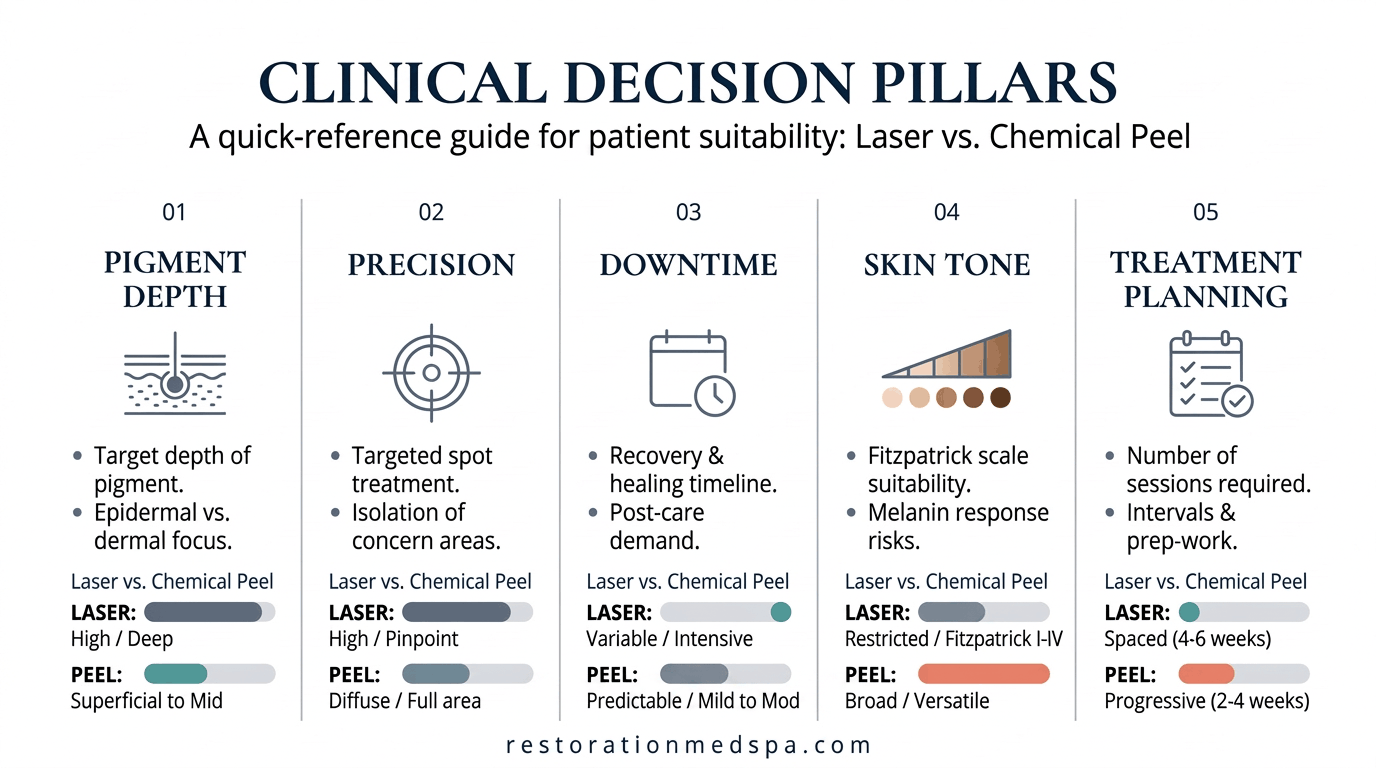
Compare Laser and Peel Across the Five Factors That Matter Most
Pigment Cause
The cause behind discoloration shapes everything that follows. Sun-induced brown spots tend to be discrete, melanin-dense, and responsive to targeted light energy. Melasma behaves very differently. Driven by hormones, UV exposure, and heat, it can flare in response to the same stimuli that treat other pigment types. A peer-reviewed consensus on lasers in melasma notes that lasers are not considered a first-line approach for this condition, and that peels or topical preparation are typically the safer starting point.
| Laser | Chemical Peel
|
|
|---|---|---|
| Sun-induced brown spots | Strong fit for discrete, defined spots | Good for diffuse surface discoloration |
| Melasma | Requires caution; heat can worsen the pattern | Often a safer first-line option |
| Post-acne marks | Effective for stubborn, persistent marks | Works well for fresh, superficial marks |
Winner: Chemical peels for melasma as a starting point; laser for discrete sun-induced pigment.
Pigment Depth
Surface pigment responds to peels because the exfoliating solution works through the upper layers of skin where that melanin sits. Deeper pigment requires light energy that can penetrate further than any topical agent. The complication with melasma is that it often exists at more than one depth at the same time. Research comparing diagnostic tools for melasma classification found that many lesions are mixed, meaning both surface and deeper pigment are present, which is why a single-modality approach can feel incomplete for many clients.
| Laser | Chemical Peel
|
|
|---|---|---|
| Epidermal (surface) pigment | Effective | Effective |
| Dermal (deeper) pigment | Can reach deeper melanin | Limited penetration |
| Mixed-depth pigment | Addresses more layers with appropriate settings | May only resolve the surface component |
Winner: Laser for deeper pigment; peels for surface concerns, with combination care often needed for mixed cases.
Treatment Precision
Lasers are calibrated to target specific chromophores, which means energy can be directed at clusters of melanin while leaving surrounding tissue relatively undisturbed. Chemical peels work more broadly across the skin surface, which is an advantage when discoloration is diffuse or paired with uneven texture. That broader action also means less control over isolated spots. Knowing which version of the problem a client has, scattered versus uniform, matters more than the treatment name when choosing between them.
| Laser | Chemical Peel
|
|
|---|---|---|
| Isolated spot treatment | High precision | Limited targeting ability |
| Broad tone correction | Moderate | Strong across the surface |
| Depth control | Adjustable by wavelength and settings | Controlled by peel strength and application time |
Winner: Laser for precision targeting; peels for broad surface renewal.
Recovery Profile
Recovery depends more on treatment intensity than on the category itself. A superficial chemical peel (starting at $100 per session at Restoration MedSpa) typically involves mild flaking over a few days. A laser session like Moxi, priced at $750 for the face, often produces redness and a sandpaper-like texture for three to five days. More intensive options in either category extend that window. For clients managing melasma, recovery carries an extra consideration: sun exposure and residual heat during healing can reactivate the very pattern being treated.
| Laser | Chemical Peel
|
|
|---|---|---|
| Mild treatment recovery | 3–5 days of redness and texture | 2–3 days of light flaking |
| Moderate treatment recovery | 5–7 days, possible swelling | 5–7 days of visible peeling |
| Post-treatment sun sensitivity | High for all skin types | High for all skin types |
Winner: Tie, based on intensity chosen; both require consistent sun protection during recovery.
Long-Term Treatment Plan
Asking which hyperpigmentation treatment works best for melasma and sun damage in the long run requires accepting that neither laser nor peel is a permanent resolution, especially when the underlying trigger is still active. The most effective plans pair in-office treatments with daily SPF, topical maintenance, and a staged sequence where one modality handles surface renewal and another addresses residual or deeper pigment. Consensus recommendations on laser use in melasma support pre-treating with brightening agents before introducing laser energy, using conservative settings, and planning for ongoing maintenance rather than expecting a single session to close the case.
| Laser | Chemical Peel
|
|
|---|---|---|
| Maintenance frequency | Periodic sessions as pigment returns | Can be repeated in a series more readily |
| Works best alongside | SPF, topical brighteners, possible peels | SPF, topical care, possible laser for deeper spots |
| Role in melasma management | Cautious addition after pattern stabilizes | Often part of the first-line approach |
Winner: A combination plan for both melasma and sun damage; long-term results depend on consistent home care alongside any in-office treatment.
How to Choose Based on Skin Tone, Sensitivity, and Schedule
Your skin’s history matters as much as its current appearance when choosing a pigment treatment. The same dark spot on two different people can behave very differently under a laser or peel, depending on how reactive the skin is, how easily it produces pigment under stress, and how much recovery time is genuinely available.
When comparing how laser treatments and chemical peels work for darker skin tones, these factors tend to matter most:
- Skin tone and Fitzpatrick type, since higher melanin levels carry a higher post-inflammatory hyperpigmentation risk when heat or irritation is misjudged.
- History of melasma or reactive pigment, which often calls for a gentler, staged approach rather than an aggressive single session.
- Your realistic recovery window, because a plan you can’t complete won’t deliver results.
- Sun exposure habits, since consistent photoprotection is what protects any treatment outcome long-term.
The right fit comes down to provider judgment, not just the treatment name.
Why Expert Assessment Changes the Outcome
When you’re looking at a dark spot in the mirror, it’s easy to assume any pigment-targeting treatment will move things in the right direction. The reality is that brown spots from sun damage, melasma, and post-acne marks can look nearly identical on the surface while sitting at completely different depths and responding to very different interventions. Treating them all the same way is one of the most common reasons clients plateau or, worse, see their discoloration worsen.
At Restoration MedSpa, a Greensboro hyperpigmentation consultation starts with identifying the cause before a single treatment is discussed. That sequence matters more than it might seem:
- Cause-first evaluation helps distinguish sun damage from hormonal melasma early, which changes the entire approach to treatment.
- Skin tone and history are factored in from the start, so recommendations account for how your skin produces pigment under stress, not just how it looks today.
- Assessment-led planning means the recommendation might be a peel, a laser, a carefully staged combination, or a preparation phase before any in-office treatment begins.
Clients at Restoration MedSpa consistently describe feeling genuinely heard and guided rather than steered toward a service. That reflects a concierge-style philosophy where education comes first, and the plan is built around your skin, your schedule, and your long-term goals.
If you’re ready to understand what’s actually behind your discoloration and which path forward makes the most sense for you, request an appointment to get started.
Laser vs Peel for Hyperpigmentation FAQs
What downtime should I expect after laser vs peel for hyperpigmentation?
It depends on the treatment intensity and your skin’s response. Laser resurfacing can range from minimal redness that clears within a day or two with lighter options, to a week or more of peeling and temporary darkening with more intensive treatments. Chemical peels follow a similar pattern, with superficial peels often causing light flaking for a few days and deeper peels requiring more recovery time.
Is laser or a chemical peel better for hyperpigmentation?
Neither is universally better. The right choice depends on what caused the discoloration and how deep it sits. Sun damage, melasma, and post-acne marks each behave differently, which is why a provider assessment matters before any treatment begins.
Can melasma be treated with laser?
Melasma requires a careful approach because heat and irritation can sometimes worsen the pattern. Some laser options are appropriate, while others are not, and a staged or combination plan is often safer than an aggressive single treatment.
How are darker skin tones evaluated for treatment safety?
Providers assess skin tone alongside pigment type to reduce the risk of post-inflammatory discoloration. Brown spot removal at Restoration MedSpa starts with this kind of individualized evaluation before any device or peel is selected.
Do I need multiple sessions to see results?
Most clients benefit from a series of treatments, and a realistic plan accounts for your schedule and sun exposure habits. Consistency and proper aftercare, including daily sunscreen, directly affect how lasting your results are.
Ready to find out which option fits your skin? Request a consultation and let Restoration MedSpa build a plan around your pigment pattern, not a one-size-fits-all protocol.
The Best Next Step Is a Personalized Plan
Most people come in expecting to choose between laser and a chemical peel. What they often leave with is a clearer picture of why neither works in isolation for their specific pattern, and a staged plan that addresses both the surface discoloration and what is driving it. A PubMed relapse study confirms that melasma and related conditions carry a real risk of returning, which means the goal is a strategy built to last, not a single session. Combination hyperpigmentation research shows that layered approaches often outperform single-modality care, particularly when pigment is stubborn or sits at more than one depth.
At Restoration MedSpa, lasers and light-based hyperpigmentation treatments in Greensboro are matched to your pigment pattern first. When assessment confirms laser is the right fit, it is paired with peels, topical preparation, or combination sequencing as your skin calls for. That sequencing is the plan.