

Key Takeaways:
- Botox is the same product for everyone, but the right injection plan changes with your facial anatomy, muscle movement, brow structure, and aesthetic goals.
- Men do not automatically need more Botox because dosage should follow muscle strength and wrinkle severity, not a gender-based formula.
- Natural-looking results come from precise placement, conservative dosing, and a clear consultation that defines how refreshed, expressive, or subtle you want to look.
The question almost every new male client asks lands somewhere between skepticism and genuine curiosity: is this treatment actually designed for me, or will I leave with a softened version of someone else’s plan? It’s worth asking. Botox is the same product regardless of who receives it. What actually changes from one plan to the next are the variables a skilled provider reads in your specific face: muscle strength, brow position, and movement patterns that can differ as much between two men as they do between a man and a woman.
Gender can influence facial muscle strength, bone structure, and what you’re hoping to walk away with, and clinical research confirms those factors matter when mapping injection points and determining dosage. But none of that replaces an individual assessment.
Whether you want to look rested for a Monday morning meeting or soften deep forehead lines without losing expression, the goal is a result that fits your face and your life. At Restoration MedSpa, that’s exactly how every Botox treatment plan is built: around you, not a template.
What Facial Differences Actually Change a Botox Plan?
Knowing that treatment is “personalized” is one thing. Understanding which specific features actually shift the plan helps you walk into a consultation with a clearer picture of what your provider is reading, and why two people with nearly identical concerns can leave with very different injection maps.
Does Botox placement really change from person to person?
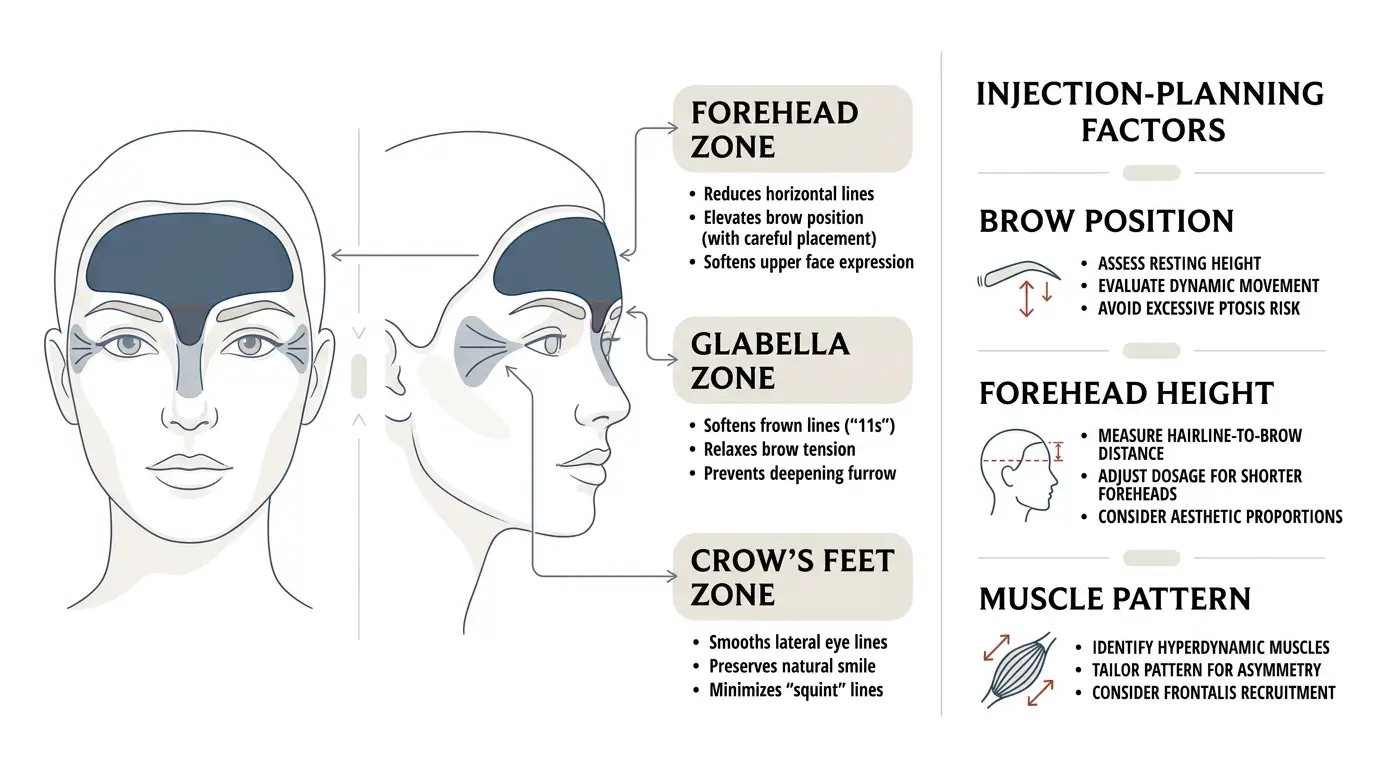
Yes, and the reason comes down to anatomy. Research on corrugator supercilii injections shows that muscle depth, position, and brow morphology vary significantly between individuals. A provider adjusts needle angle, depth, and injection point based on your specific muscle pattern, not a standard template.
How does brow position affect the plan?
Brow position directly drives injection placement strategy. Sexual dimorphism research confirms that the orbital and brow region shows some of the most pronounced structural variation between individuals, shaped by underlying bone structure and how muscles pull on the skin. Someone who wants a stronger, horizontal brow needs a very different placement than someone seeking a softer, lifted arch.
Why can two people with the same forehead lines need different injection points?
Similar lines on the surface don’t mean identical movement patterns underneath. Clinical review data shows that dynamic contraction patterns vary widely, and injecting at the wrong point, even by a few millimeters, can alter brow position or reduce movement in unintended areas. Mapping follows the muscle, not the wrinkle.
Does a heavier brow ridge or wider forehead shift how treatment is planned?
It can. A prominent brow ridge changes how the frontalis muscle sits and how much it contributes to lifting. Treating that zone too aggressively risks a heavy or dropped brow. Providers account for forehead height and ridge depth when determining how many injection sites to use and where to stay clear.
Are areas like crow’s feet and the jawline planned around gender or overall facial balance?
Facial balance drives those decisions more than gender does. Crow’s feet placement depends on how far the muscle extends and how close it sits to the orbital rim. Jawline treatments follow the size and activity of the masseter muscle. Your facial proportions, not a demographic, tell the injector what the plan needs to achieve.
Do Men Usually Need More Botox, or Is Dosage Fully Individual?
Most people arrive expecting a simple rule: men need more units, women need fewer. What the research actually shows is more useful. Muscle strength and wrinkle severity are the real drivers of dosage, and both vary enough from person to person that gender alone tells a provider very little. Here’s what actually shapes how much product ends up in your plan.
Does biological sex determine how many units you’ll need?
Not on its own. A 2024 clinical study found that muscle strength pattern and wrinkle severity, not sex, are the real drivers of dosage. Men in the sample did average slightly more units, but the difference wasn’t statistically significant. Your muscle activity and skin depth matter far more than your gender.
Why do some men end up needing more units?
Facial muscles in men tend to be larger and more active, partly because greater lean mass supports stronger muscle contraction overall. A provider who considers your facial-balancing goals will assess actual muscle movement during your consultation rather than assume dosage based on gender alone.
Can a woman ever need the same units as a man in the same area?
Absolutely. A woman with strong glabellar muscles and deep frown lines may need the same number of units, or more, than a man with moderate muscle activity in that zone. Dosage follows the face, not the person’s sex.
Does a higher dose mean a stiffer, more frozen result?
Not when it’s planned well. The clinical guidance on individualized injection planning is clear: strategic dosage and precise placement work together to address muscle activity while preserving natural movement. More units in the right spots can actually look more natural than under-treating a strong muscle.
How does a provider decide whether to adjust dosage after the first visit?
Most experienced injectors treat conservatively on the first visit, then assess results at a follow-up. This staged approach lets your provider fine-tune based on how your muscles respond, which is especially useful if you’re new to Botox or working toward a specific look through your personalized treatment plan.
How Do Providers Keep Results Natural for Different Goals?
The fear most clients name before a Botox appointment has nothing to do with the needle: it’s looking like they had something done. Whether someone wants a refreshed appearance for the boardroom or a relaxed brow that still moves, the same principle applies: precise placement and honest communication produce results that fit your life.
What does “natural-looking” actually mean for a male client?
For most men, the goal is to look rested and polished, not expressionless. Clinical research on male Botox patients consistently points to preserving masculine facial contour and dynamic movement while softening lines. At Restoration MedSpa, that means a plan calibrated to your features, not a softened version of someone else’s result.
Can Botox smooth forehead lines without flattening expression?
Yes, and technique is everything. Global aesthetic consensus guidelines recommend lower doses and precise injection points to allow natural animation while still reducing the appearance of lines. The goal is selective relaxation, not full restriction, so your face still moves the way it should.
How does facial balance factor into the treatment plan?
Facial balance considers how each area relates to the whole face, not just the wrinkle being treated. A provider looks at brow position, forehead height, and muscle activity together before deciding on placement. Our facial balancing approach treats the face as a system, which is how results stay proportional and natural.
What should I tell my provider if I want subtle results?
Say exactly that. Phrases like “I don’t want anyone to notice” or “I want to still look expressive” give your injector clear direction. At your appointment, your provider will assess your movement and muscle activity before treatment begins. Being specific in consultation is the most reliable way to avoid an overarched brow or an overdone appearance.
How does a personalized plan work for someone with an active, professional lifestyle?
A custom Botox plan accounts for more than facial anatomy: it accounts for how you live. For clients balancing client-facing work, fitness routines, and a full schedule, treatment is designed to work around your schedule. Results that hold up at the gym and across the table from a client start with a provider who asks the right questions before picking up a syringe.
Choose a Personalized Botox Plan, Not a Gender Template
The most useful question to ask before booking Botox isn’t “Is this treatment for men or women?” It’s whether your plan is built around your specific facial anatomy, muscle patterns, and goals. Clinical research consistently reinforces this: meaningful differences in dosing and placement come from individual assessment, not a gender-based formula. A thoughtful consultation covers brow position, movement patterns, and the degree of softening you actually want before a single unit is placed.
At Restoration MedSpa, every consultation starts with your face, not a demographic. Whether your goal is a sharper, rested look for the boardroom or simply more ease in your expression at the end of a long week, your provider maps brow position, movement patterns, and exactly what you want before a single unit is placed. Botox is $14 per unit, and your total reflects what your plan actually calls for.