


Key Takeaways:
- Most men need about 6 to 8 laser sessions for back hair, but the right plan starts with your hair pattern and goals, not a one-size-fits-all promise.
- Hair density, skin-to-hair contrast, uneven growth across the back, and the size of the area all shape how many sessions you will actually need.
- Results are built through consistently timed visits, usually spaced 4 to 8 weeks apart, and some men may need occasional maintenance to keep long-term reduction on track.
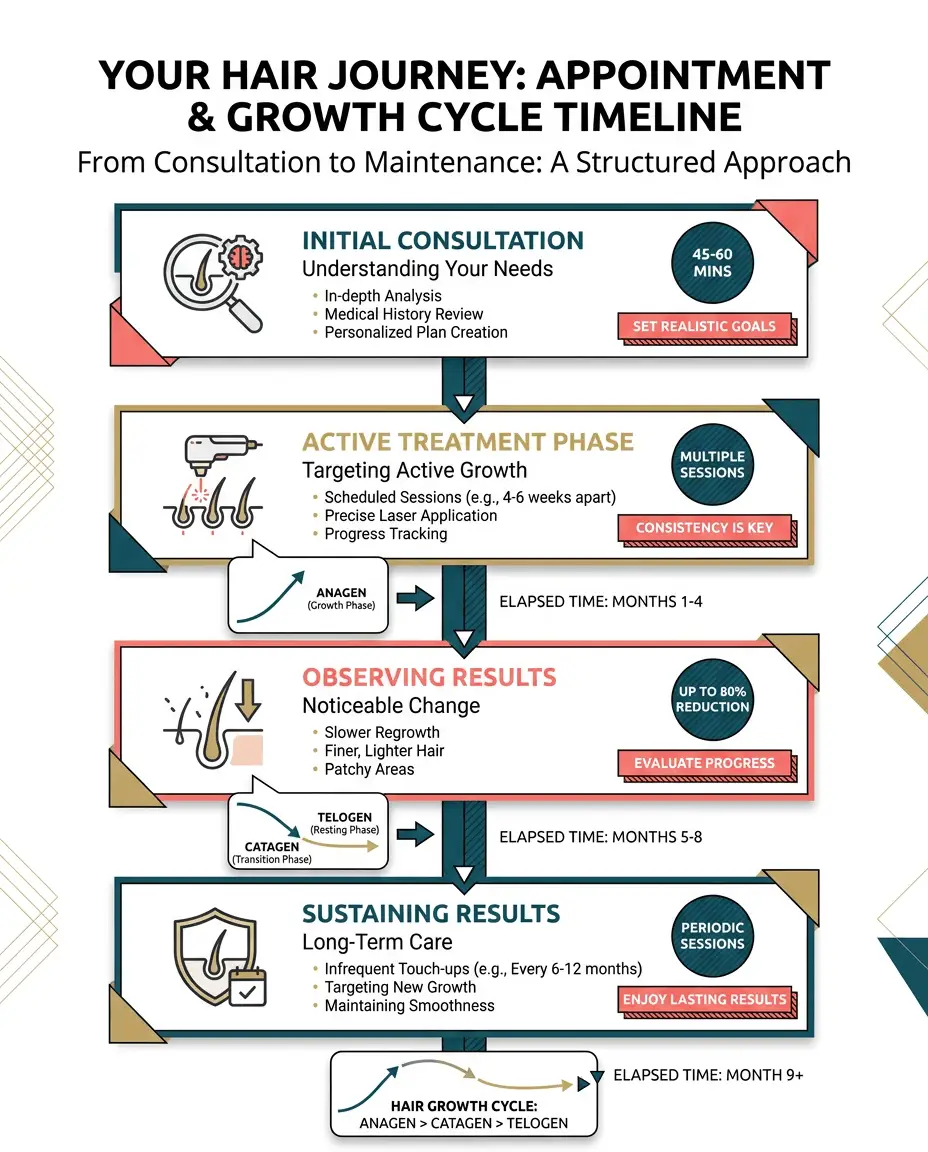
Most men expect laser hair removal to wrap up in a visit or two. It doesn’t work that way. Laser targets hair only during its active growth phase, and each follicle cycles through that phase at its own pace, so a series of treatments is always required.
For men’s back hair, most clients need 6 to 8 sessions, spaced 4 to 8 weeks apart. The right number depends on four variables: hair density, skin and hair contrast, the size of the treatment area, and how consistently sessions are timed.
At Restoration MedSpa, every plan starts with a personalized assessment rather than a generic promise. Request your personalized plan.
What Is a Realistic Starting Estimate for Men’s Back Hair?
Men planning laser hair removal on their backs often want a specific number before they commit. The honest answer is that there is a reliable range, but where you land within it depends on factors specific to your back, not a blanket industry figure.
How many sessions do men typically need for back hair?
Most clients need somewhere between 6 and 8 sessions to achieve a meaningful, lasting reduction, in line with the American Academy of Dermatology’s general range of 4–8 sessions. The back often tends toward the higher end due to its size and variation in hair density across zones.
Does treating the full back take more planning than a smaller area?
Yes. The back is one of the largest treatment areas on the body, and hair growth across it is rarely uniform. Upper back, lower back, and shoulder zones can each behave differently, which means your provider needs to plan for consistent, even coverage rather than treating the area as a single, predictable surface.
Will treating just part of the back change the session count?
Focusing on only the upper or lower back may allow for more targeted coverage per visit, but the session count is still driven by hair growth cycles, not surface area alone. A partial-back plan can be a practical choice depending on your goals, and your provider can help you decide whether a full or partial approach makes more sense for your hair pattern.
What can men with dense, coarse back hair realistically expect?
Coarse hair can actually respond well to laser energy because it absorbs heat efficiently. Widespread density across the full back simply means more follicles to reach over the series, which is why consistent scheduling is what drives cumulative results.
What should you expect after the first few sessions?
Early sessions typically produce noticeable shedding and a visible thinning of regrowth rather than complete clearance. That is completely normal. The goal of the first few treatments is to interrupt active growth cycles, so each subsequent session builds on the last. Expecting gradual progress, not immediate results, is the mindset that leads to the best long-term outcome.
What Changes the Number of Sessions You Will Need?
No two backs are the same, and the gap between a generic session count and your actual number comes down to four specific variables. Knowing what they are is what separates a realistic plan from an estimate that leaves you surprised mid-treatment.
How does back hair density and thickness affect session count?
Denser, thicker hair means more follicles absorbing laser energy in each pass. According to the Mayo Clinic, most people need between 4 and 8 sessions, but coarser, more densely packed hair often sits toward the higher end of that range. Thicker follicles can require more energy per treatment to achieve lasting reduction.
Does skin tone and hair color contrast really make that big a difference?
It does, and it’s one of the most important variables in your plan. Laser energy targets melanin (the pigment in hair), so a strong contrast between hair color and skin tone allows the laser to lock onto follicles more precisely. Clients with that favorable contrast often see effective results; those with lower contrast may need more sessions or a different device approach, such as the Aerolase, which is well-suited for a broader range of skin tones.
What if my back hair is patchy rather than evenly distributed?
Patchy growth actually calls for a more targeted plan, not fewer sessions. Uneven coverage means some follicles are in different growth phases at any given time, so the laser catches different areas at peak effectiveness on different visits. A provider who maps your specific growth pattern will plan coverage accordingly, rather than treating the whole back with a single, uniform approach.
Can coarse back hair still respond well, even if it seems harder to treat?
Coarse hair is not automatically a harder case. As research in dermatology literature shows, thick, dark hair with good contrast can actually absorb laser energy efficiently, producing a strong follicular response. The challenge comes when coarseness is paired with low skin-to-hair contrast or hormonal factors that keep driving new growth between sessions.
Why is an in-person assessment more reliable than researching session counts online?
Online averages are drawn from broad populations, not your back. An in-person consultation at Restoration MedSpa allows a provider to evaluate your hair density, thickness, contrast, and coverage area. That combination produces a realistic, honest session estimate, not a number that sounds convenient but leaves you surprised mid-treatment.
How Should Sessions Be Timed, and Will Maintenance Be Needed?
Timing matters as much as the number of sessions. Getting the spacing right is what separates steady, visible progress from a frustrating plateau, and understanding why you do helps you stay committed to the full plan.
Why can’t sessions be scheduled back-to-back to finish faster?
Laser energy only disables hair follicles that are actively growing, a phase called anagen. At any moment, only a portion of your back hair is in that window. The AAD recommends intervals of four to six weeks between sessions to catch new follicles as they cycle in.
What is the right spacing for men’s back hair specifically?
Most providers recommend sessions spaced six to eight weeks apart for body areas like the back. At Restoration MedSpa, our laser hair removal plans are built around four- to eight-week intervals, adjusted to how your back hair actually grows.
When will results start to look noticeably different?
The Cleveland Clinic notes that each session typically reduces active hair by ten to twenty-five percent. That means meaningful change becomes visible over several consistently timed visits, not after one or two. Staying on schedule is what keeps that momentum building.
What can slow progress down?
Stretched-out gaps between sessions, inconsistent coverage across the full back, or stopping the series early are the most common reasons results stall. Missing a treatment window means follicles you could have caught simply restart their cycle. Completing the recommended series, without long breaks, is what drives lasting reduction.
Will any maintenance be needed after the main series is done?
For most men, back hair reduction is long-lasting, but hormonal shifts can reactivate some follicles over time. Occasional maintenance touch-ups may be recommended to manage any finer or returning growth. Your provider will factor this into your plan from the start, so there are no surprises later.
Get a Personalized Back Hair Removal Plan at Restoration MedSpa
There is no honest universal session count for men’s back hair. Most clients complete the series in six to eight sessions, but where you land depends on hair density, skin-to-hair contrast, and how consistently you stay on schedule. Those variables are only readable in person, which is exactly why a consultation produces a realistic timeline and a generic estimate never will.
At Restoration MedSpa, laser hair removal plans are built around education and honest timelines, including upfront guidance on whether maintenance treatments will be needed once your main series is complete. If you’re in the Greensboro, Winston-Salem, or High Point area, explore our Lasers and Light services and request a plan built around your back, not an average.