


Key Takeaways:
- Most men need more forehead Botox than women because the male frontalis muscle is usually stronger, but the right dose still depends on how your forehead actually moves, not a standard chart.
- For many men, the forehead falls in a 20 to 30 unit range, yet line depth, forehead size, muscle pattern, and whether you also treat frown lines can shift the total up or down.
- Natural-looking results come from a movement-first plan with precise placement and, when needed, a conservative starting dose, which is why Restoration MedSpa builds each treatment around your anatomy and goals instead of chasing a frozen look.
Ask ten men how many Botox units they need for the forehead, and you’ll get ten different answers, because the honest answer is that there isn’t one. The common assumption is that men simply need a few more units than women to account for the muscle. The more accurate picture is that male forehead dosing requires a different calibration entirely: larger frontalis muscles, stronger movement, and a goal that usually involves preserving more natural expression rather than fully relaxing the forehead. A number that works on paper can go wrong in practice.
What most men are looking for is a forehead that looks smoother and more rested, without losing the natural movement that makes a face look like theirs. That balance requires a careful read of how the forehead moves both at rest and in expression, because expert consensus guidance shows that underdosing fades fast while overdosing can flatten normal expression.
At Restoration MedSpa, every forehead Botox plan for men starts with exactly that kind of assessment. Ready to find your number? Request a forehead Botox consultation and get a plan built around how your face actually moves.
What Is the Typical Botox Dosage Range for Men’s Foreheads?
The Botox dosage range for men varies more than most people expect, and that range exists for good reason. Understanding why providers land on different numbers helps make sense of the recommendation you receive at your own consultation.
How many units do men typically need for forehead lines?
Men typically need 20 to 30 units for the forehead, though the right count depends on muscle strength and movement patterns. Clinical consensus guidance documents that men with moderate forehead movement often receive around 2 units per treatment point, with higher totals for stronger muscle activity.
Does treating the forehead alone require fewer units than combining it with frown lines?
Yes, in most cases. Treating just the forehead addresses the horizontal lines above the brows. Adding the glabella (the frown line area between the brows) means more muscle groups are involved, which increases the total unit count. Your provider will map out exactly which areas need attention before recommending a combined plan.
Why do men often need more units than women in the same area?
It comes down to anatomy. Research on sex-based dosing differences consistently shows that men’s forehead muscles tend to be larger and generate stronger movement, so more units are needed to achieve meaningful softening. What often goes unsaid: the target outcome differs too. Most men want a forehead that moves less, not one that stops moving. That distinction shapes the dose as much as the muscle size does.
Can a lower starting dose still work for men who want subtle softening?
It can. A 2024 study on targeted injection techniques found that precision placement allowed providers to use fewer total units while still achieving meaningful line reduction and high patient satisfaction. For men who want to soften movement without fully smoothing the forehead, a conservative starting point with a scheduled follow-up is a reasonable approach.
What does it mean when a provider recommends more units than expected?
It usually means your forehead muscles are more active than average, or that the lines present are deeper and require broader coverage. A higher recommendation means the provider is matching the dose to what your anatomy actually requires. You can always review the reasoning, ask questions, and review Restoration MedSpa’s Botox approach before committing to anything.
What Factors Change How Many Units a Man Needs?
The unit count that works well for one man may fall short for another, even when their foreheads look similar in photos. Several real, measurable factors shape the right dose, and understanding them explains why a personalized assessment matters far more than a standard number.
How does male forehead anatomy and muscle strength affect the dose?
Men tend to have larger, heavier frontalis muscles than women, and that bulk directly influences how much neurotoxin is needed to soften movement. Clinical guidance places the typical forehead dose for men at 20–30 units, compared to lower ranges for women. Greater muscle mass simply requires more units to achieve the same softening effect.
Why do deeper lines and stronger muscle movement change the plan?
Deeper, well-established lines often reflect years of strong, repetitive muscle contraction. A peer-reviewed consensus on tailored Botox injection notes that muscle tone categories, from kinetic to hyperkinetic, directly shape both the dose and the depth of each injection. Mild lines on a less active forehead may respond well to fewer units.
Does forehead size or muscle pattern affect where units are placed?
Yes, and placement is just as important as total unit count. A wider forehead or an asymmetric muscle pattern means injection points need to be mapped differently to distribute the effect evenly. Treating the wrong points, even at the right total dose, can lead to uneven results or unwanted brow heaviness.
Can age, prior Botox, or how the body metabolizes treatment shift the dose?
All three can. Men who are newer to Botox may respond well to a conservative starting dose, while those with a longer treatment history often have a clearer baseline for their provider to work from. Metabolism also varies; some men notice their results fading faster, which a systematic review on male upper-face dosing points to as a known source of inconsistency in standard recommendations.
Why does movement matter more than what the forehead looks like at rest?
A forehead can appear relatively smooth at rest but show deep creasing the moment brows lift or expressions shift. Assessing how the muscles move in real expressions, not just in a still image, gives the provider the information needed to dose accurately. That live movement assessment is what separates a plan built for your face from a generic unit count.
How Do Providers Personalize Forehead Botox for Natural-Looking Results in Men?
Getting the dose right matters, but so does knowing exactly where to place it and how much movement to preserve. These questions walk through what personalized planning actually looks like for men who want a smoother forehead without losing what makes their face theirs.
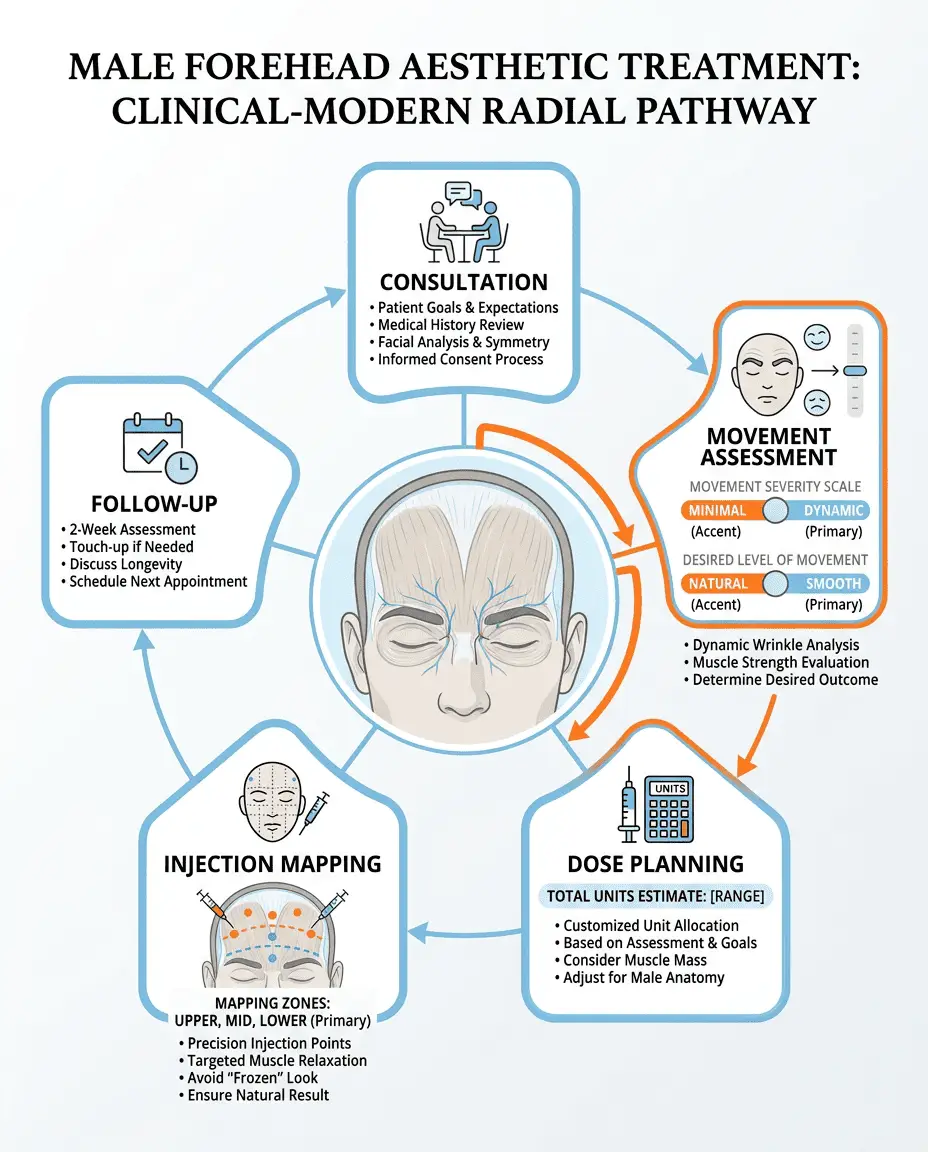
What happens during a forehead Botox consultation for men?
A provider will watch how your forehead moves, not just how it looks in a photo. They assess muscle strength, line depth, and your goals before recommending a plan. That movement-first approach is what separates a result that looks like you from one that looks like a treatment. See our forehead Botox page for details on what to expect at your visit.
What does “natural-looking” actually mean for the forehead?
For men, natural means the forehead moves less without going completely still. Some horizontal lines at full expression are often intentional. The goal, as outlined in our Botox for men guide, is a refreshed appearance that reads as confident and rested, not altered.
How do providers avoid a heavy brow or that “frozen” look?
Injection placement plays as big a role as unit count. Peer-reviewed consensus recommends placing injections roughly 1.5 to 2.0 cm above the brow and adjusting for individual muscle patterns. Placing too low or using too many units near the brow can pull it down and flatten the face.
Should men start with a lower dose on their first visit?
For first-time clients, a conservative starting dose makes sense. It lets the provider see how your muscles respond before committing to a full treatment. A Botox touch-up visit a few weeks later can add units if more softening is wanted, which is a safer path than correcting an overdone result.
What does forehead Botox cost, and how often will men need to come back?
At Restoration MedSpa, Botox is priced at $14 per unit. A typical male forehead treatment in the range of 20 to 30 units would run $280 to $420. Results typically last three to four months; see our Botox pricing and longevity guide for details on planning your visits.
Get a Personalized Forehead Botox Plan That Fits Your Features
The unit count is the last thing your provider should decide, not the first. The real work is understanding how your frontalis muscle moves in a real expression, how deep your lines run, and exactly how much softening your face and your goals call for. Clinical guidance consistently points to individualized assessment over standardized dosing as the path to natural-looking results for men, and that sequence matters: movement first, unit count second.
A well-matched plan keeps your forehead smoother without flattening your expression or pulling your brows in a direction that feels off. Men in Greensboro, Winston-Salem, and High Point can get exactly that at Restoration MedSpa, where consultations are educational, discreet, and built around how your face moves, not a one-size-fits-all unit count.
Ready to find out what your forehead actually needs? Request your forehead Botox appointment for a treatment plan shaped around your anatomy, your goals, and nothing else.