Key Takeaways:
- IPL can meaningfully reduce rosacea redness when the concern is diffuse flushing or visible surface vessels, but it is not the best fit for every redness pattern or every skin type.
- The most important step before rosacea redness treatment is a consultation that maps where redness appears, what triggers it, and how reactive your skin is, so the plan supports your skin safely.
- At Restoration MedSpa, the best results come from matching the device and treatment schedule to the patient, which may mean using IPL, BBL, or Aerolase, or calming the skin first, rather than forcing a one-size-fits-all approach.
Not every flush tells the same story. The diffuse pink that lingers after a glass of wine, the fine capillaries mapped across the cheeks, the reactive redness that spikes with sun or stress: these are all rosacea, and they do not all respond to the same device. IPL and similar treatments can meaningfully reduce rosacea-related redness, but that evidence is precise. It applies to specific patterns, not to all redness indiscriminately.
That distinction matters if you are looking for a laser treatment for rosacea redness in Greensboro. The most important question is not simply whether IPL works. It is whether IPL is the right fit for your specific skin, your redness triggers, and your goals. What follows covers who tends to benefit most, what a careful consultation should include, and what you can realistically expect from treatment. To explore light-based options with an expert team, visit Restoration MedSpa.
Is IPL Effective for Rosacea Redness?
IPL, or intense pulsed light, uses broad-spectrum light to target the small blood vessels that give rosacea-prone skin its persistent red appearance. Whether IPL is effective for rosacea redness depends less on the technology itself and more on whether it matches how redness appears on your skin.
When IPL Can Actually Help
IPL works by delivering light energy that is absorbed by the reddish pigment in blood vessels near the skin’s surface. Clinical research confirms that IPL can reduce visible redness in erythematotelangiectatic rosacea, the type characterized by diffuse flushing and visible capillaries. An earlier case series of 32 patients also found meaningful improvements in redness and flushing with minimal side effects. For those redness patterns, IPL is a well-supported option.
When IPL Is Not the Right Fit
IPL is not a universal answer. Patients with darker skin tones, active inflammation, or significant skin sensitivity may not tolerate standard IPL settings well. Rosacea that flares unpredictably or involves deeper vessel involvement may respond better to a more targeted device. At Restoration MedSpa, alternatives like BBL offer added versatility for different skin types and redness patterns.
The Two Questions Every Recommendation Should Answer
A responsible treatment plan starts with two questions: can IPL reach and reduce the redness, and will this patient’s skin tolerate it safely? Skipping either question risks making redness worse instead of better. That careful, two-part assessment is what turns a generic protocol into a plan your skin can actually respond to.
Who Is a Good Candidate for Rosacea Redness Laser Treatment in Greensboro?
The clearest sign you may be ready for light-based treatment is redness that simply won’t settle down. If your skin stays visibly flushed even after adjusting your skincare routine, avoiding known triggers, and giving it time, that persistent redness is worth discussing with a provider. That kind of redness often points to dilated surface vessels or ongoing vascular activity that topical products can’t fully reach on their own.
Candidacy goes well beyond a rosacea diagnosis, though. A provider should look at your skin tone, how reactive your skin feels day-to-day, whether visible vessels or general background redness is the bigger concern, and whether any active inflammation is present. Choosing a device before that picture is clear can lead to results that fall short or skin that feels pushed too hard. The better starting point is a provider who evaluates your specific skin before making any recommendation.
What a Rosacea Redness Consultation Should Cover Before IPL
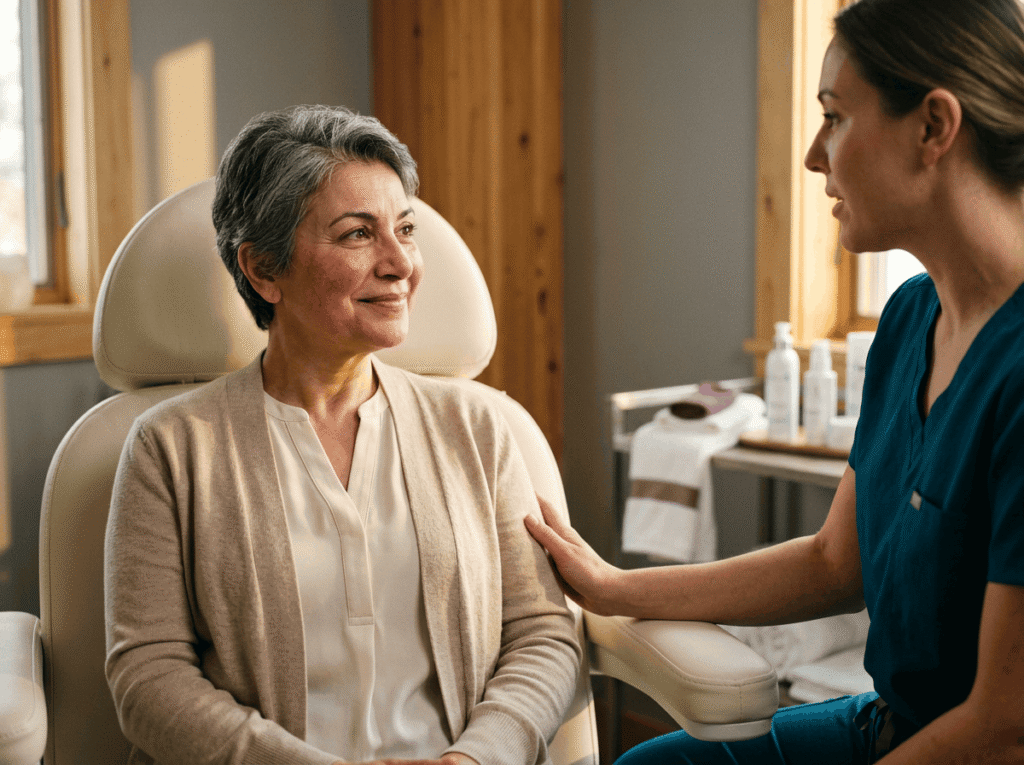
A rosacea and facial redness consultation in Greensboro should establish three things before any IPL or laser treatment is introduced: the pattern of your redness, your skin’s day-to-day reactivity, and a recommendation built around your specific situation. That assessment shapes not just which device is right, but whether to use one at all right now.
Mapping Your Redness Pattern
Not all redness looks or behaves the same way. A provider should ask where the redness shows up, how long it lingers, and what brings it on. They should also distinguish between diffuse background flushing and visible surface vessels because those two patterns can call for different devices or different sequences of treatment entirely.
Reviewing Skin Sensitivity and Current Routine
Your skin’s day-to-day reactivity matters just as much as the redness itself. A thorough evaluation should cover your current skincare products, recent sun exposure, any treatments you’ve had recently, and whether your skin barrier feels compromised. According to rosacea treatment guidelines, medications and photosensitizing products are also part of the pre-treatment picture. Pushing light-based energy into a reactive, barrier-compromised skin often creates more irritation, not less.
Leaving With a Personalized Plan
The right consultation doesn’t end with a standard package. Depending on what the assessment shows, the recommendation might be IPL, an alternative like BBL, staged sessions spaced further apart, or a plan to calm the skin first before any device is introduced. Clinical practice supports individualizing both device selection and session timing based on severity, skin type, and treatment history. A personalized recommendation protects your skin and gives your results the best possible foundation.
Rosacea Redness Laser Treatment Greensboro: Frequently Asked Questions (FAQs)
When skin is already reactive, the right questions before treatment matter as much as the treatment itself. Here are the ones patients with rosacea-related redness most often raise, and what the evidence and our providers’ experience actually show.
What results and downtime can I expect from light-based treatment for rosacea-related redness on sensitive skin?
Most patients see gradual improvement over several weeks rather than overnight. According to the American Academy of Dermatology, visible vessels can reduce by 50 to 75 percent, with short-term redness or mild bruising typically resolving within one to two weeks. A 2025 multicenter study found that roughly 70 percent of patients achieved greater than 75 percent clearance within three to four months.
How many sessions are commonly needed before redness looks calmer and clearer?
There is no universal number, and that is by design. A systematic review in IJDVL found that most protocols used three to four sessions spaced about three to four weeks apart. For some patients, the Aerolase NeoElite protocol at Restoration MedSpa calls for four to six sessions at two- to four-week intervals, depending on how the skin responds.
If my skin is very sensitive, how do providers make light-based treatment more comfortable and appropriate?
Device choice and settings do most of the work. Options like the BBL with integrated cooling or the Aerolase NeoElite are designed to manage heat carefully on reactive skin. Providers can also lower fluence, extend session spacing, or choose an alternative laser modality if IPL is not the safest fit for a particular skin tone or sensitivity level.
Choose a Personalized Path for Calmer-Looking Skin
Whether IPL works for rosacea is the wrong question. The research settled that long ago. The question that actually determines whether your skin gets calmer or more reactive is whether this device fits this redness pattern on this skin, right now. Outcomes depend on how well the device fits the patient, not just the condition, and that fit only becomes clear through a real assessment, not a standing protocol.
That fit comes from careful assessment, not a default recommendation. At Restoration MedSpa, the Lasers & Light Greensboro approach is built around exactly that: advanced technology guided by expert evaluation so the plan supports your skin, not someone else’s. If calmer, clearer-looking skin is the goal, the next step is a conversation with a provider who can assess your skin and develop a plan for it.
Request an appointment to find out which light-based option is the right fit for your redness.